Saturday, November 30, 2019

Car Insurance


The Best Travel Comparison Tool,
We compare between millions of flights to help you find the cheapest and best offer. We also offer hotels and car rentals, all in one place and few clicks@
  
No Hidden Costs!
We offer full price transparency and charge no hidden costs. We operate simply by displaying the most relevant, cost-effective offers. Our goal: to help you make an informed choice.
Partnerships with Top Brands
Tripbase collaborates with acclaimed brands such as Renatalcars.com, Trivago, Booking.com, and many more to bring you the best offers from all over the web. We practice what we preach, and do it well enough to receive great reviews.

Are multi car policies cheaper?

Not only will Admiral MultiCar save you time and paperwork if you insure more than one car, it can also save you money - £248 actually.
Although individual policies could be cheaper, with Admiral you get our MultiCar discounts for every car on cover.
And 10% of customers who gave us a best alternative quote between Jan 2019 – Jun 2019 saved £248 with Admiral MultiCar!

How does multi car discount work?

Insure multiple cars on one policy and get an Admiral MultiCar discount for every car you add. You’ll get an immediate discount when the policy starts and every car you add earns its own discount. Add your friends and family to the policy to earn more discounts.
The cheapest multi car insurance on the market might not be the best option for you so take the time to read the features and benefits included in the policies you’re looking at.
It’s important you have the right level of cover for every vehicle, so you’re not left short should you ever need to make a claim.
If you’re comparing multiple car insurance quotes, be sure to come to Admiral directly as our MultiCar Insurance isn't on comparison websites and we believe it’s the best there is.

Our customers love us

Look at what they're saying...
Financially well worth it. Good follow up from their customer dept. I really appreciate their others offers for eg recovery deal and the time spent to explain to us the benefit of having MultiCar.
Ion
August 2017
Low prices comparing with others and excellent customer service.
Gayle, St.Helens
August 2017
The staff who dealt with me were knowledgeable, polite and at times humorous. This may not seem important to a lot of companies but to me they are at the forefront of the company and the most important part of the sale. Admiral staff passed with flying colours.

Car Insurance


     Car Finance

"I really liked that it gave me all my options for car finance. It was a great, easy experience!"
Roxanne, October 2019

5 gold stars


Hire Purchase (HP)

Hire purchase or HP is an arrangement where you hire the car from a finance company until you’ve fully paid for it. The company own the vehicle until the final payment is made, after which time it’s yours to keep. Hire purchase tends to require a deposit usually 10% of the car’s value. The higher the deposit, the lower the monthly payments.
Personal contract purchase explained

Personal Contract Purchase (PCP)

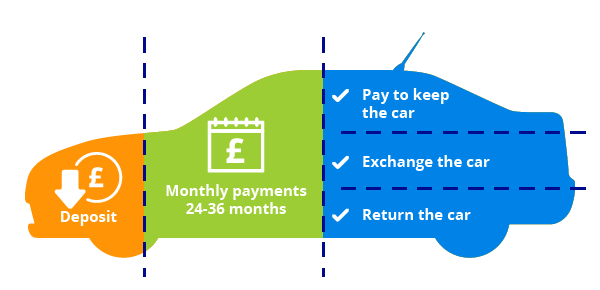
Personal contract purchase or PCP is similar to hire purchase. You’re likely to be asked to pay an initial deposit, and then monthly payments for a set period. The higher your deposit, generally, the lower the monthly payments. Even with the deposit though, monthly payments are typically lower than you’d find with a hire purchase deal or a personal loan. This is because you'll be paying off the value of the depreciation of the car, not the full value of the car.
At the end of the agreement, if you decide you want to keep the car, you’ll need to pay what’s known as a ‘balloon payment’. This covers the cost of the vehicle and transfers ownership from the finance company to you. If you don’t want to keep the vehicle, you can give it back, or start a new PCP deal and get a new car.
Personal loans explained

Personal Loan

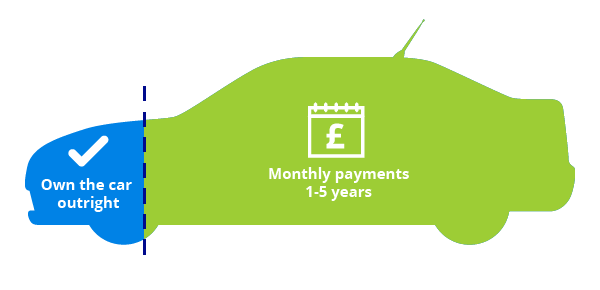
A personal loan sometimes called an unsecured loan, allows you to borrow a lump sum over a fixed term. This isn’t secured against anything. That means if you use a personal loan to pay for your car, you’ll own it outright from the day the money is transferred to the dealer. As such, you can sell the vehicle at any time, without needing to settle up with the finance company first. If you think this would be a better option for you then you may want to visit our page for a quote.


How can I save?


Before taking out a car loan, you need to take into account how much you're spending, how much you can afford to pay back each month and how good your credit history is. The great way to compare deals is to look at the total cost of credit as this will take into account the monthly payments, and how long you'll end up paying back the loan for. One thing to be careful of when comparing finance deals is that, while extending the period may bring down the cost of monthly payments, it could also mean you'll pay more interest overall.

Can I get car finance if I have bad credit?

Your credit history is taken into account when you apply through us. But even if you have poor credit, or you are completely new to it, it doesn't mean you'll be rejected, or that your only option is to take out finance through a car dealer. Instead, it will probably mean that your monthly payments and / or the amount you repay overall are higher than some of the rates you've seen advertised. And you may only get quotes from a limited number of “specialist” providers. To find out more, take a look at our guide on how to improve your credit rating

Understanding your options

Everyone has a different financial situation, so there's no 'one size fits all' with financing your next car.
Before you start looking for a car loan, you'll need to think about a few questions, such as:
Savings icon
Do you have any savings for a deposit?
Monthly spend icon
How much can you afford to pay back each month?
Borrow icon
How much do you want to borrow?
landlord insurance icon
What's your credit history like?
Renew icon
Are you likely to change your car again within the next three years?
Car icon
Have you chosen the car yet?
Savings icon
Is it a private sale, or through a dealer?
Spend icon
How much are you looking to spend?
Once you've answered these questions, you'll be in a much better position to choose the best way to fund your next car.
Need more help? Take a look at our car finance jargon buster.

Car finance

Travel insurance


Travel Insurance for Adventure Activities


Understand the key parts of

World Nomads travel insurance,

We cover 150 activities you love + more,

Here’s this year’s top 10 activities under each category that World Nomads love to do:
Not all activities are covered under every plan - click here to read the full list. You may have to upgrade the policy and sporting level to make sure you’re covered for everything you plan to do. Please read your policy wording carefully before you buy it.
Snow
Water
Air
Land
Sports
Experiences
  • Scuba diving
  •  
  • Mountain biking
  •  
  • Surfing
  •  
  • Bungee jumping
  •  
  • Skiing  
    • Stories about discovery

    • Stories about discovery

      The best journeys don’t just show us the unfamiliar – they help us understand it. In these stories, our nomads dive deep into the local culture in search of the beliefs, desires, and history behind the customs.


Travel Insurance


    Travel insurance for independent travellers and intrepid families. You'd rather not think about all of the things that might go wrong on your trip, but these things can and do happen. World Nomads travel insurance has been designed by travellers for travellers, to cover your trip essentials. Even if you run out of travel insurance or leave without it, World Nomads can cover you. We don't just keep you and your family protected, with us, you'll travel smarter and safer.


Buy travel insurance while travelling
If you're travelling and want to travel longer, World Nomads lets you buy more cover to keep you on the road

24/7 Emergency Assistance
Our multi-lingual assistance team can help you when you need it most, connecting you with medical treatment and transportation.


Travel Cover for 200+ Adventure Activities
At World Nomads, we love to explore our boundaries when we travel, so we've worked for over ten years developing one of the longest lists of covered activities
Donate to local communities
We connect our customers to projects run by established charities so you can fund projects in destinations with the greatest need.

24/7 emergency assistance

If you need medical assistance or emergency medical evacuation our team is available 24 hours a day, 7 days a week, 365 days a year before and during your trip.
Are you in need of emergency assistance right now?
Phone: +353 21 237 8005 (Call via an operator reverse charges. Not toll free.)
Phone: +61 2 8263 0470 (Call via an operator reverse charges. Not toll free.)
Contact the team

Thursday, November 28, 2019

Cheap Auto Insurance


Auto Insurance,,,

Find answers to your car insurance questions,

 including what policy is right for you, insurance rules, and pricing.


Get important information on how to save money while getting the coverage you need.

What Is Subrogation?

Subrogation is a term describing a legal right held by most insurance carriers to legally pursue a third party that caused an insurance loss to the insured. This is done in order to recover the amount of the claim paid by the insurance carrier to the insured for the loss.
When an insurance company pursues a third party for damages, it is said to "step into the shoes of the policyholder," and thus will have the same rights and legal standing as the policyholder when seeking compensation for losses. If the insured party does not have the legal standing to sue the third party, the insurer will also be unable to pursue a lawsuit as a result.

How Subrogation Works

Subrogation literally refers to the act of one person or party standing in the place of another person or party. Subrogation effectively defines the rights of the insurance company both before and after it has paid claims made against a policy. Subrogation makes obtaining a settlement under an insurance policy go more smoothly.
In most cases, an individual’s insurance company pays its client’s claim for losses directly, then seeks reimbursement from the other party, or his insurance company. The insured client receives payment promptly, which is what he pays his insurance company to do; then, the insurance company may pursue a subrogation claim against the party at fault for the loss.
Insurance policies may contain language that entitles an insurer, once losses are paid on claims, to seek recovery of funds from a third party if that third party caused the loss. The insured does not have the right both to file a claim with the insurer to receive the coverage outlined in the insurance policy and to seek damages from the third party that caused the losses.
Subrogation in the insurance sector, especially among auto insurance policies, occurs when the insurance carrier takes on the financial burden of the insured as the result of an injury or accident payment and seeks repayment from the at-fault party.
One example of subrogation is when an insured driver's car is totaled through the fault of another driver. The insurance carrier reimburses the covered driver under the terms of the policy and then pursues legal action against the driver at fault. If the carrier is successful, it must divide the amount recovered after expenses proportionately with the insured to repay any deductible paid by the insured.
Subrogation is not only relegated to auto insurers and auto policyholders. Another possibility of subrogation occurs within the health care sector. If, for example, a health insurance policyholder is injured in an accident and the insurer pays $20,000 to cover the medical bills, that same health insurance company is allowed to collect $20,000 from the at-fault party to reconcile the payment.

KEY TAKEAWAYS

  • Subrogation is a term describing a legal right held by most insurance carriers to legally pursue a third party that caused an insurance loss to the insured. 
  • Subrogation makes obtaining a settlement under an insurance policy go smoothly. In most cases, an individual’s insurance company pays its client’s claim for losses directly, then seeks reimbursement from the other party, or his insurance company.
  • Subrogation is most common in an auto insurance policy but also occurs in property/casualty and healthcare policy claims.

Special Considerations

The Subrogation Process for the Insured

Luckily for policyholders, the subrogation process is very passive for the victim of an accident from the fault of another party. The subrogation process is meant to protect insured parties; the insurance companies of the two parties involved work to mediate and legally come to a conclusion overpayment. Policyholders are simply covered by their insurance company and can act accordingly. It benefits the insured in that the at-fault party must make a payment during subrogation to the insurer, which helps keep the policyholder's insurance rates low.
In the case of an accident, it is still important to stay in communication with the insurance company. Make sure all accidents are reported to the insurer in a timely manner and let the insurer know if there should be any settlement or legal action. If a settlement occurs outside of the normal subrogation process between the two parties in a court of law, it is often legally impossible for the insurer to pursue subrogation against the at-fault party. This is due to the fact most settlements include a waiver of subrogation.

Waivers of Subrogation

A waiver of subrogation is a contractual provision whereby an insured waives the right of their insurance carrier to seek redress or seek compensation for losses from a negligent third party. Typically, insurers charge an additional fee for this special policy endorsement. Many construction contracts and leases include a waiver of subrogation clause.
Such provisions prevent one party’s insurance carrier from pursuing a claim against the other contractual party in an attempt to recover money paid by the insurance company to the insured or to a third party to resolve a covered claim. In other words, if subrogation is waived, the insurance company cannot "step into the client's shoes" once a claim has been settled and sue the other party to recoup their losses. Thus, if subrogation is waived, the insurer is exposed to greater risk.

Get 15% welcome bonus up to $500

Trade forex and CFDs on stock indices, commodities, stocks, metals and energies with a licensed and regulated broker. For all clients who open their first real account, XM offers a 15% welcome bonus up to $500 to test the XM products and services without any initial deposit needed. Learn more about how you can trade over 1000 instruments on the XM MT4 and MT5 platforms from your PC and Mac, or from a variety of mobile devices.                 AND

Taxes. You really can't avoid them. From terminology to laws, learn everything you need to know about how and when taxes are applied.